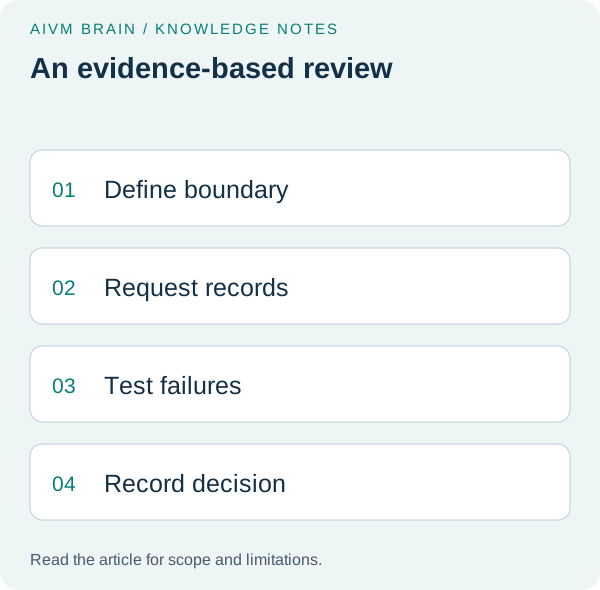
What should enterprise reviewers ask about verifiable AI?
Enterprise reviewers should ask what the system claims to verify, which boundary the claim covers, and what evidence they can independently inspect. Begin with an actual retrieval request rather than a generic security presentation. Identify the requester, source, policy decision, and returned context, then map the record to the controls that produced it and the paths it does not cover.
The verifiable AI pillar defines the concept; the company AI security review guide translates it into a review agenda. Ask the vendor to describe a failure case. A clear account of a bypass boundary, missing event, or stale policy is more useful than a claim that cryptography eliminates all trust.
Which records belong in the evidence package?
The evidence package should contain representative permitted and denied requests, relevant policy snapshots or references, identity mappings, and integrity verification instructions. Include a diagram showing the retrieval and logging boundaries. The reviewer should be able to connect each field to an observed event and understand which components must be trusted for the claim to hold.
RFC 9162 provides a useful technical example of inclusion and consistency proofs in transparency logs; it is not a claim that Brain implements that protocol. Use comparable precision when describing your own evidence. Hash integrity, event authenticity, and logging completeness are separate properties with different tests and trust assumptions.
| Claim | Artifact | Negative test |
|---|---|---|
| Authorization was enforced | Identity, policy reference, decision | Request a controlled forbidden source |
| Record is tamper-evident | Export and verification procedure | Alter an exported record |
| Relevant paths are covered | Architecture and route inventory | Exercise alternate read and preview tools |
| Revocation takes effect | Revocation event and follow-up request | Retry with the revoked identity |
Does a vendor certification establish verifiable access?
A vendor certification or assurance report does not itself establish a particular retrieval event. It addresses controls within its stated scope and period, whereas access verification examines evidence for the event under review. Both can be useful, but the reviewer must understand what each covers. Avoid treating a compliance logo as proof that a specific document was never disclosed.
AIVM Brain, from AIVM, describes SOC 2 and ISO 42001 as in progress, not achieved. Our enterprise AI brain guide discusses the organizational requirements. Assess available evidence now: identity, source permissions, admin controls, audit retention, and incident handling. Record missing assurance documents as review gaps instead of implying their completion.
How can reviewers test a claim of no restricted access?
Reviewers cannot infer universal absence of restricted access from an empty log alone. They need a defined system boundary, evidence that all relevant paths enforce authorization, and tests that exercise denied access and policy changes. State the conclusion narrowly: the tested identity could not retrieve the controlled source through the tested paths under the observed conditions.
Use a synthetic restricted document and two identities, then test search snippets, full reads, stale sessions, and direct tool calls. Repeat after revocation. The company-data evaluation checklist helps turn those observations into acceptance criteria. Include uninstrumented integrations in the architecture review; a perfect receipt from one service cannot describe traffic that bypassed it.
How should the enterprise turn evidence into a decision?
The enterprise should turn evidence into a decision by agreeing on acceptance criteria before the demonstration and recording unresolved risks afterward. Assign owners for access review, source hygiene, incident response, and periodic retesting. Match the evidence burden to the information sensitivity and deployment scope. A limited successful pilot should not automatically authorize every source or every agent in the company.
IBM’s 2026 Cost of a Data Breach report reports a global average of US$4.99 million, 12% above the prior year. These broad survey figures motivate disciplined review; they are not a forecast of your risk or a measured saving from Brain. Use the pricing and deployment information only after the required controls and operational ownership are clear.