What does verifiable AI mean for company knowledge?
For company knowledge, verifiable AI means making specific access and provenance claims checkable after a request completes. A reviewer should be able to connect an identity, policy decision, source reference, and answer record. The term also appears in other fields, including verifiable computation; this guide focuses on knowledge access and its evidence.
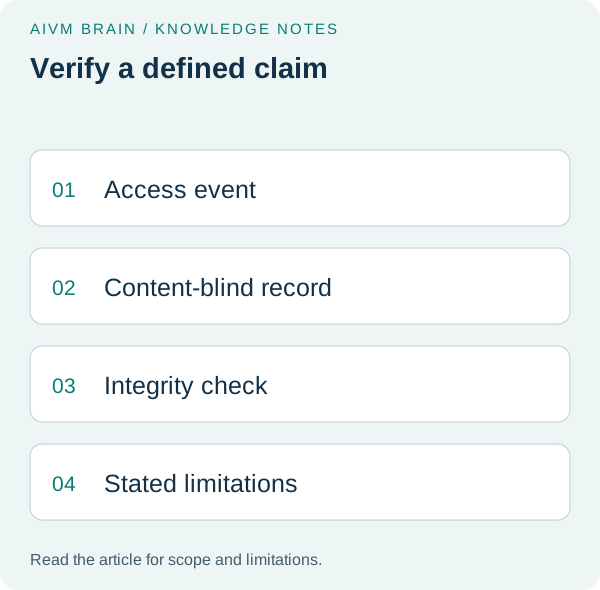
Begin with a precise question: which policy version governed this agent's request, and which source references were returned? That question can have a reproducible verification procedure. A broader claim that an AI system is trustworthy needs many other kinds of evidence. The distinction is central to governed versus verifiable company AI.
In Anthropic’s April 2025 hint experiments, Claude 3.7 Sonnet acknowledged used hints in 25% of cases on average, versus 39% for DeepSeek R1. These historical experimental figures concern explanation faithfulness, not access-control performance. They reinforce the need for evidence separate from the model’s account.
How does verifiable AI differ from governed AI?
A useful access record associates a request identifier with the requesting principal, time, policy context, outcome, and permitted source references. Depending on the implementation, it may also record withholding decisions and an output digest. Reviewers need documented field meanings: a retrieved reference, a citation displayed to a user, and model input are different observations.
A content-blind record avoids copying document bodies into the audit log. It can still reveal sensitive relationships through identifiers or timestamps, so the log needs its own permissions. Our guide to an AI audit log explains the operational purpose. Ask for a sample export and a schema before accepting a vendor's description of what is recorded.
How do cryptographic records make tampering detectable?
Cryptographic records make some changes detectable by binding events to hashes, signatures, or committed tree roots. Verification recomputes those relationships and checks them against a trusted reference. The exact guarantee depends on the design: proving an event belongs to a committed set is different from proving the set contains every event that should exist.
RFC 9162 describes inclusion and consistency proofs for certificate-transparency logs. It is a useful example of precise log guarantees, not a claim that Brain implements that protocol. For an AI audit, ask where checkpoints are kept, how signing keys are trusted, and whether the vendor could replace both the record and the only reference used to verify it.
Does independent anchoring make the AI's answers true?
Independent anchoring can bind a commitment to an external reference, reducing dependence on the operator's current database. It cannot establish that the original source was correct, that the model interpreted it well, or that an event omitted before commitment occurred. An anchor preserves evidence about a record; it does not validate every claim inside that record.
The concept is covered in anchoring proof on-chain. Brain's existing guide describes on-chain anchoring as planned, so it should not be treated as a deployed prerequisite for using its audit trail. External timestamping and on-chain anchoring are distinct mechanisms; an evaluation should identify which mechanism the offered deployment actually uses.
How is access verification different from content provenance?
Access verification concerns what a system recorded about a request and its authorization. Content provenance concerns the origin and history of an asset. They can reinforce one another, but neither substitutes for the other: a valid provenance manifest does not grant permission to read a document, and an authorized retrieval does not establish its factual truth.
The C2PA technical specification defines signed claims and assertions associated with content. Our discussion of content provenance explains its relevance to knowledge workflows. Treat source authenticity, permission, record integrity, and answer quality as separate checks with evidence appropriate to each one.
How can an outside auditor verify an AI access claim?
An outside auditor needs the exported record, verification procedure, relevant trust material, and a clearly defined scope. They can then test the claimed cryptographic relationships independently. They must separately assess whether all relevant access paths were instrumented, how identities were bound to requests, and whether the policy snapshot accurately represents the rules at that time.
AIVM Brain, from AIVM, brings permission enforcement and a content-blind audit trail into company knowledge retrieval. Use the short guide to governed vs verifiable AI for the basic distinction, then ask an evaluator to replay a permitted request, a denied request, and an altered export. Record what each test establishes and what remains outside its scope.