How do explainable AI and verifiable AI differ?
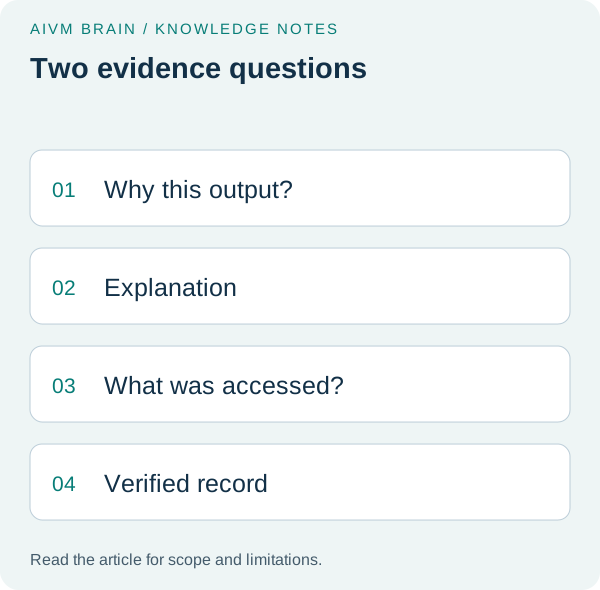
Explainable AI and verifiable AI differ in the question they answer. Explainability helps a person interpret how a system reached a result. Verifiability supplies a procedure for checking a specific assertion, such as whether an exported retrieval record has changed. These capabilities can complement each other, but a system can provide one without providing the other.
The verifiable AI definition sets the access-evidence boundary. In a refund dispute, an explanation may describe how the policy influenced the recommendation. The retrieval record instead identifies the policy version returned, the requesting identity, and the recorded authorization decision. Neither establishes that an incorrect policy was legally or operationally appropriate.
| Question | Explainability evidence | Verifiability evidence |
|---|---|---|
| Why this recommendation? | Interpretable decision factors and limitations | May not establish the reasoning |
| Which source was returned? | A narrative can mention a source | Authenticated retrieval event and source reference |
| Was the exported record altered? | An explanation cannot settle this | An integrity check against trusted reference material |
Does visible reasoning prove what an AI read?
Visible reasoning does not prove what an AI read. It is an output of the system, potentially useful for interpretation but not a complete record of its inputs or their causal influence. Independently recorded tool events are a better basis for access investigations. Those records still need authenticated identities, adequate coverage, and a way to detect alteration.
In Anthropic’s April 2025 reasoning study, Claude 3.7 Sonnet acknowledged used hints in 25% of tested cases on average; DeepSeek R1 did so in 39%. These were controlled hint experiments, not production incident rates or results for current models. They illustrate why a reasoning narrative should not substitute for access telemetry.
What makes an explanation useful to a reviewer?
A useful explanation addresses the reviewer’s question in terms they can understand and accurately represents what is known about the system. Feature attribution, counterfactual examples, and a description of the decision procedure serve different audiences. Label post-hoc explanations as such and state their limits. Avoid presenting generated reasoning as a faithful transcript of hidden computation.
P. Jonathon Phillips and colleagues organize NIST’s explainable AI principles around explanation, meaningfulness, explanation accuracy, and knowledge limits. Apply them to the refund example: show the policy clause, explain why it matters, distinguish the model’s interpretation from an approved rule, and surface uncertainty when the evidence is incomplete.
What evidence should verifiable AI provide?
Verifiable AI should provide evidence matched to a precisely stated claim. For an access review, request an export that binds request identity, time, source references, and the recorded decision. Ask how integrity is checked and what trusted reference anchors the check. Separately assess omitted events, direct connector access, and any retrieval path outside the logging boundary.
Governed versus verifiable systems separates runtime enforcement from later inspection. AIVM Brain, from AIVM, applies that distinction to company knowledge. A content-blind ledger limits replication of sensitive text, while source references support investigation. It records access evidence, not the model’s private reasoning or a guarantee of factual correctness.
Which should a company evaluate first?
A company handling restricted knowledge should first establish the retrieval permission boundary and the evidence needed to audit it, then evaluate explanations against its decision risk. The order depends on the use case: understanding a consequential recommendation may be as important as proving authorized access. Assign owners to both requirements instead of choosing one marketing label as a substitute.
Run separate demonstrations. Ask the model to explain a recommendation, then ask an investigator to validate its retrieval receipt without the conversation transcript. Alter a copy of the receipt and repeat verification. Read about independent audit anchoring before treating an external timestamp as evidence of completeness or truth; its integrity claim is narrower.