Why does AI agent security include reading?
Reading belongs in the security model because an agent can disclose information simply by answering a question. If a retrieval tool returns an entire confidential document, the model has already received it before anyone reviews the final response. Preventing a later payment or file edit does not undo that exposure or make the underlying retrieval appropriate.
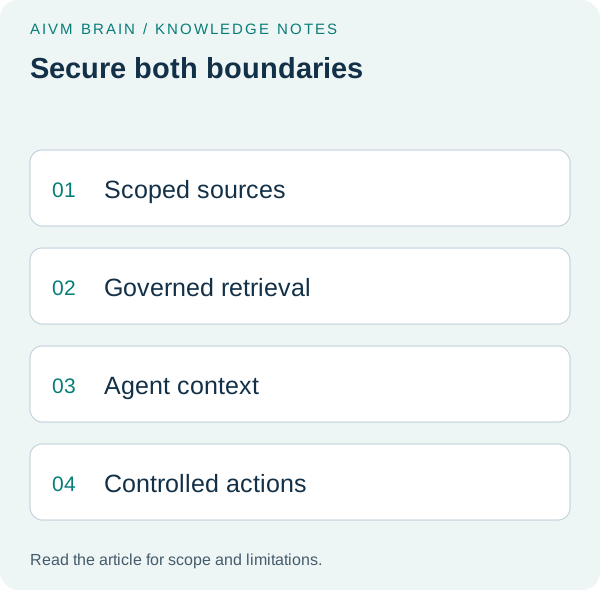
A support assistant asked to explain a service outage may need the incident summary but not customer credentials stored in an attachment. The agent access safety discussion starts from this boundary. Secure the path into context, then secure where that context can be sent or repeated.
What are the main AI agent security threats in retrieval?
The main knowledge-access threats are excessive source permissions, cross-team context leakage, poisoned documents, and credentials that grant more access than a task requires. These threats can combine. A malicious paragraph in an otherwise legitimate source might direct an agent to retrieve another source, carry its contents into a new tool call, and conceal the result.
The OWASP AI Agent Security Cheat Sheet treats prompt injection, tool use, memory, and permission boundaries as connected concerns. A document being internal does not make every sentence authoritative. Comments, pasted customer messages, and imported pages may originate from people who were never authorized to instruct the agent.
How should permission-aware retrieval work?
Permission-aware retrieval should authenticate the agent and apply applicable source permissions before releasing content to its model. Additional task scope can narrow those permissions. Sensitive sections may need separate treatment inside an otherwise permitted document. Apply the same decision to search snippets, full reads, summaries, and subsequent requests, or an alternate surface can bypass the intended restriction.
For a practical rollout, create two test identities with different access and ask identical questions about a harmless test document. Check titles, snippets, and error messages as well as answer text. Our guide to preventing AI oversharing explains why inherited access still requires a review of existing source sharing.
Why should every agent have a separate identity?
Each agent needs a separate identity so its access can be limited, attributed, and revoked without treating an entire fleet as one user. Bind that identity to an owner and a purpose. A development assistant, finance analyst, and support automation should not inherit one powerful credential merely because the same administrator configured all three.
NIST's zero trust architecture centers access decisions on resources and explicit authorization rather than implicit trust from location. Apply that principle to agents: membership in your infrastructure is not permission to read every company source. Define ownership and expiry through agent knowledge governance, then test revocation against the actual serving path.
Which controls remain necessary after retrieval is scoped?
Scoped retrieval limits what a compromised agent can reach, but it does not make allowed documents free of malicious instructions. Separate retrieved evidence from trusted task instructions, restrict available tools, validate destinations, and require approval for consequential operations where appropriate. Output controls are also necessary when an agent can send permitted information to an unintended audience.
An engineer's agent may legitimately read a runbook and still be forbidden to post it in a public issue. A purchasing agent may read a supplier email without gaining authority to pay its invoice. AIVM's execution-security example illustrates the complementary action boundary with policy checks on a malicious purchasing request. Brain's knowledge-access layer addresses the earlier reading boundary.
Anthropic’s 2025 browser pilot tested 123 cases across 29 attack scenarios. That controlled scope is a reminder to enumerate your own retrieval and action paths. Its results do not establish the risk level of a company document store or the effectiveness of Brain’s controls.
How do you test and audit the knowledge-access layer?
Test the knowledge-access layer with allowed requests, denied requests, permission changes, and harmless injected instructions in controlled documents. Record the requesting identity, returned source references, policy outcome, and relevant timestamps. Then check whether an investigator can reconstruct the event without receiving the underlying sensitive content or relying solely on a screenshot from the vendor's dashboard.
Start with safe agent access to company knowledge. Include revoked credentials, stale indexes, direct reads after a filtered search, and two agents operating at different privilege levels. AIVM Brain provides scoped retrieval and a content-blind audit trail for this workflow; the deployment still needs an explicit owner for testing, incident response, and source-permission hygiene.