Where does agent knowledge governance start?
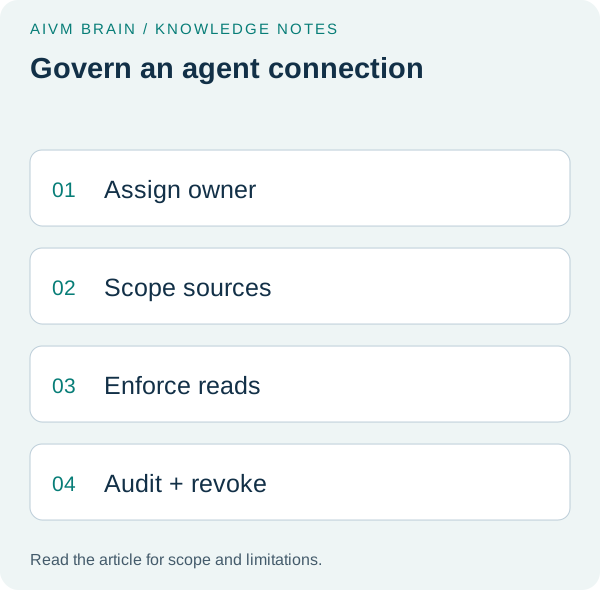
Agent knowledge governance starts with a task and an accountable owner, not with a bulk source connection. Describe what the agent must answer, which sources can support those answers, and which information is unnecessary. Translate those decisions into enforceable scope. Assign someone to approve changes and retire the connection when its original purpose no longer applies.
A release assistant might need product specifications and approved launch dates, but not acquisition plans attached to the same workspace. The agent knowledge definition explains the context being governed. Write an access matrix with an allowed example and a denied example for each role; that small artifact makes subsequent testing concrete.
| Resource | Decision | Reason |
|---|---|---|
| Approved launch calendar | Allow | Needed to answer release timing |
| Public product specification | Allow | Needed for feature descriptions |
| Compensation appendix | Withhold | Outside release task |
| Acquisition planning folder | Deny | Outside source clearance |
How should source permissions shape agent knowledge?
Source permissions should constrain agent knowledge before any text is released to the model. The requesting identity must remain associated with searches, previews, and document reads. Additional task rules can reduce access further. Existing source sharing also needs review: inheriting an overly broad permission faithfully reproduces the exposure rather than correcting it.
Follow the AI access governance guide for ownership and policy. NIST SP 800-207 grounds access in explicit resource authorization. A trusted network location or company email should not turn a contractor’s agent into a reader of all internal records. Test effective access, including inherited groups and shared links.
When should sensitive sections be withheld?
Sensitive sections should be withheld when a document combines useful task information with material the requester should not receive. Apply the same boundary to snippets, summaries, exports, and direct reads. Whole-document access is insufficient if a permitted runbook embeds credentials or personal information. Decide how the agent should explain missing context without revealing the withheld material itself.
Our explanation of how Brain controls access covers this finer boundary. Use a synthetic onboarding document with an approved process paragraph and a marked private appendix. Ask both broad and targeted questions. A successful test returns the usable process, withholds the appendix, and avoids exposing its contents through titles or generated summaries.
Why do scoped agent identities matter?
Scoped agent identities matter because access must be attributable and independently revocable. Sharing one powerful key across tools hides which connection caused an event and makes selective shutdown difficult. Associate each connection with its owner, tenant, purpose, and permitted resources. Protect credentials outside public repositories and revisit scope when the agent’s role or the owner’s membership changes.
The agent access safety article explains the impact of broad credentials. OWASP’s agent-security guidance supports least privilege and constrained tool use. A kill switch limits future requests; it does not erase content already returned. Your incident plan must also consider cached results, retained sessions, and outbound destinations.
How do you audit and maintain the boundary?
Audit and maintain the boundary by recording retrieval decisions and periodically replaying representative access tests. Include permitted reads, denied requests, changed source permissions, and revoked agent connections. Review whether every retrieval path reaches enforcement and logging. An intact record supports investigation, but absent events alone cannot prove that no uninstrumented access occurred elsewhere in the system.
AIVM Brain, from AIVM, provides permission-aware retrieval and a content-blind audit ledger. Use the safe agent access guide to plan a controlled pilot. Keep a register of source owners, connection owners, policy changes, and unresolved test failures so access review remains an operating responsibility after the initial setup.
In Anthropic’s 2025 browser pilot, attack success decreased from 23.6% to 11.2% after mitigations. This historical, controlled evaluation is not a Brain result or a current document-security rate. It illustrates why governance needs layered enforcement and repeated testing rather than one successful demonstration.