What counts as agent knowledge?
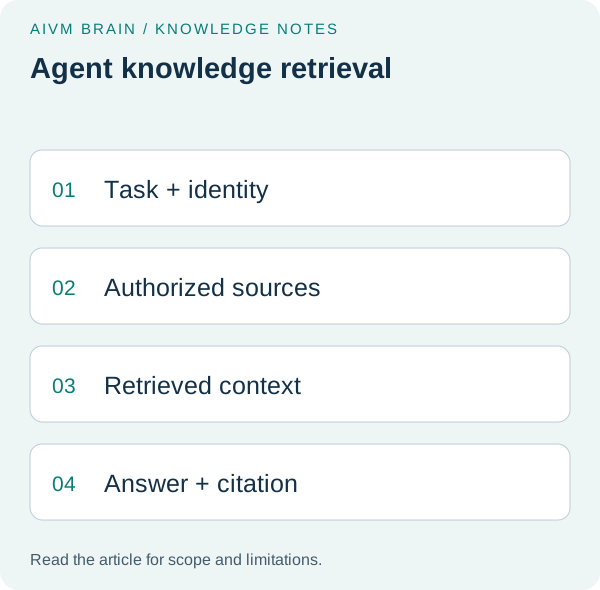
Agent knowledge includes the information available to an agent for a particular task: a customer policy, a product specification, a past decision, or a tool result. Availability matters as much as existence. A document somewhere in the company is not useful task knowledge until the agent can locate an authorized, relevant version.
Consider a support agent answering whether a customer qualifies for a refund. It needs the current policy and the customer's relevant account facts. A fluent model may know common refund practices, but those practices are not evidence of this company's policy. The AI agent brain combines reasoning with access to that task context.
How does agent knowledge differ from training and memory?
Model training supplies learned patterns and general capabilities. Session memory holds the ongoing interaction. Retrieved knowledge supplies external information at the moment a task requires it. These are useful architectural distinctions, not universal dictionary boundaries: long-term agent memory may itself contain facts, preferences, and shared knowledge derived from earlier work.
The LangGraph memory overview distinguishes thread-scoped memory from longer-lived stores and describes semantic, episodic, and procedural memory. A customer preference belongs in persistent memory; an approved refund policy belongs to its accountable source owner. Neither should automatically override the other. See what an agentic brain is for the wider system.
Where should an agent's company knowledge come from?
Company knowledge should come from sources with clear ownership and a way to track change. Policies, approved documentation, issue trackers, and business systems can all contribute. The source must remain identifiable after retrieval so that a person can inspect the evidence, resolve conflicting versions, and correct a fact at its origin.
Build a small source register before connecting everything. Record who owns each source, which tasks need it, who can read it, and how corrections propagate. A meeting transcript may establish that someone proposed a change. An approved policy establishes whether the change took effect. The distinction prevents a draft from quietly becoming operational truth.
How do agents retrieve knowledge through MCP?
Agents can retrieve knowledge by calling tools exposed through the Model Context Protocol. A client requests a search or read operation, the service authenticates and authorizes the request, and permitted results return as context. MCP standardizes the connection; it does not define whether a particular company's access policy is correct.
The MCP security guidance makes clear that secure integrations require deliberate authorization design. Keep a separate identity for each agent and avoid forwarding credentials to unintended services. Our guide to an MCP knowledge base for agents explains how this interface fits the retrieval architecture.
How do you keep agent knowledge current?
Current knowledge requires an update path, not merely a connection to a live application. Connectors may synchronize changes, caches may retain results, and an agent may continue reasoning from context retrieved earlier. Track the source version and retrieval time, define acceptable delay, and decide how deletions and permission changes invalidate previously available material.
Test freshness with a harmless policy change. Update the source, ask a new question, and inspect the cited version. Then revoke access and repeat with the affected identity. These are different tests: fresh text does not guarantee fresh permissions. A service should also make sync failures visible so that silence is not mistaken for current knowledge.
Di Wu and colleagues’ LongMemEval study evaluates 500 questions across five memory abilities, including knowledge updates. These benchmark dimensions suggest useful freshness tests; they do not measure Brain or establish whether a source permission was enforced.
Why does shared agent knowledge need governance?
Shared knowledge needs governance because relevance does not establish permission. A search system may find an excellent answer in a document the requester is forbidden to read. Authorization should therefore constrain retrieval before the content reaches the model, while the resulting record identifies the request and the policy decision for later review.
For example, an engineering agent can read a migration runbook without receiving the compensation appendix attached to the same project. Apply permission-aware retrieval, explicit source ownership, and scoped agent identities. AIVM Brain, from AIVM, is built around this shared, governed use of company knowledge. Start by connecting an agent through the current workspace setup.