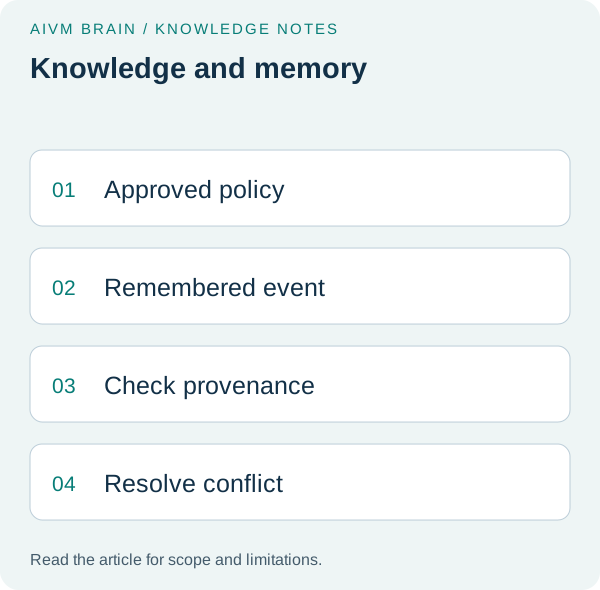
How do agent knowledge and agent memory overlap?
Agent knowledge and agent memory overlap whenever a remembered fact becomes information used in a later task. Their difference is operational rather than absolute. Knowledge management asks which source should be treated as authoritative; memory management asks what should persist from earlier interactions. A robust design records both origin and intended use instead of inferring authority from the storage location.
The agent knowledge guide defines the broader context. LangGraph’s memory documentation recognizes semantic, episodic, and procedural memory, plus different persistence scopes. Calling every memory store a private diary would miss those capabilities. Conversely, placing a policy in a vector store does not establish ownership, currency, or permission.
| Example | Authority | Correction owner | Sharing rule |
|---|---|---|---|
| Approved refund policy | Current approved source | Policy owner | Requester’s source clearance |
| Remembered refund discussion | Historical statement | Conversation or memory owner | Purpose and participant scope |
| Agent execution trace | Observed event | System operator | Incident and retention policy |
Why does agent knowledge need an authoritative source?
Agent knowledge needs an authoritative source when the agent must distinguish an approved rule from a suggestion or recollection. A conversation saying that refunds may extend beyond the usual window is not itself an approved exception. Preserve the document owner, version, approval state, and retrieval time so a conflicting memory can be checked against current policy.
Imagine an account manager mentioning a proposed discount in a meeting. The agent remembers it. Later, the signed agreement sets a different discount. The contract should govern the answer, and the remembered proposal should remain labeled as historical context. A useful system surfaces the conflict rather than silently combining the figures into a confident response.
Should agents share their memories?
Agents should share memory only where its purpose and access boundary justify sharing. Shared project decisions can prevent duplicated work; private preferences, sensitive customer details, and experimental reasoning may need narrower scope. A shared namespace is therefore a permission decision, not just a storage setting. Identify who can read, update, correct, and remove each class of remembered information.
Letta explicitly supports attaching and detaching memory blocks, including sharing across agents. Our Letta comparison addresses its architectural fit. For organizational deployment, assess shared multi-agent memory with two identities: sharing a block should not erase differences in the source permissions of the people those agents represent.
What do memory benchmarks actually measure?
Memory benchmarks measure performance on their defined recall and reasoning tasks, not whether a company’s authorization policy was enforced. Inspect the dataset, model, retrieval settings, and evaluation procedure before comparing results. A high answer score may coexist with excessive access; a strict permission boundary may correctly withhold information that an unrestricted benchmark assumes the model should receive.
Di Wu and colleagues’ LongMemEval benchmark contains 500 questions spanning five memory abilities. Its evaluation includes updates and abstention, useful categories for testing stale or missing context. Those research results are not a comparison of Brain’s security controls. Our Mem0 comparison likewise separates the memory-engine choice from the governance requirement.
How should retention and correction differ?
Retention and correction should follow the information’s purpose. An approved policy may remain available with a version history, while a transient conversation detail may expire quickly. A correction must propagate into summaries, embeddings, and other derived memories where applicable. Deleting the source alone does not establish that every downstream representation or previously retrieved context has been removed.
Build a correction exercise around a harmless outdated address: change the authoritative source, invalidate the derived memory, and ask a fresh session for the address. Then inspect older sessions separately. Accountable AI memory connects that lifecycle to evidence. AIVM Brain, from AIVM, focuses on governed access to company knowledge; write-back to connected documents remains on the roadmap.