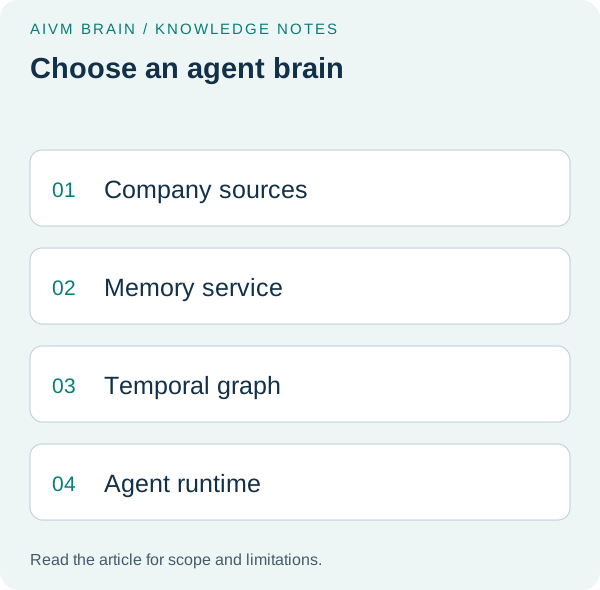
How should you rank the best AI brain for agents?
Rank the best AI brain for agents by the job it must perform, then verify the capabilities that job requires. For company retrieval, prioritize source permissions, individual agent scope, revocation, and access evidence. For an application memory subsystem, prioritize storage semantics, correction, latency, and integration effort. A single numeric score would conceal these materially different requirements.
Disclosure: Brain is our product. The shortlist ranks fit for distinct jobs, based on documentation reviewed on 11 September 2026, rather than benchmark performance. The broader AI brain tools guide covers the overall market. Treat a missing documented feature as an evaluation question, not proof that the vendor cannot provide it.
| Rank for stated job | Candidate | Primary fit | Governance check |
|---|---|---|---|
| 1 | AIVM Brain (ours) | Permissioned company retrieval for a fleet | Demonstrate source controls, mandates, revocation, and evidence |
| 2 | Mem0 | Persistent application memory | Map memory identity scopes to source authorization |
| 3 | Zep / Graphiti | Temporal relationships and context | Separate hosted controls from self-managed responsibilities |
| 4 | Letta | Stateful agents with explicit memory blocks | Test block sharing and application authorization |
When is AIVM Brain the best AI brain to evaluate?
AIVM Brain is the strongest fit on this shortlist when multiple agents need governed access to existing company sources, with section-level controls and an audit record. The requirement is shared knowledge with different permissions for different requesters. Its role is to make access enforceable and reviewable while the connected agent remains responsible for reasoning and its own tool behavior.
Brain comes from AIVM. Evaluate mandates, human approval where applicable, exposure reports, and revocation alongside retrieval. The second brain for agents guide describes the shared context pattern. Current connected-source capability is governed read; document write-back remains on the roadmap. Agent memory writes and edits to external source documents are different operations.
When should you choose Mem0 for agent memory?
Mem0 is worth evaluating when you need persistent application memory with tools to save, retrieve, update, and remove remembered information. Its hosted MCP service can expose memory across supported clients, so it should not be described as inherently limited to one agent. Examine how its identity scopes and administration controls map to the application you are building.
The Mem0 MCP documentation describes the integration surface. Our Mem0 comparison focuses on the difference from Brain’s company-source access model. Ask whether the candidate directly enforces the permissions of each connected company source or whether your application must implement that boundary. A shared memory namespace alone does not answer the question.
When do Zep and Letta fit better?
Zep and Letta fit different architectural needs. Zep’s Graphiti ecosystem models changing relationships and facts in a temporal graph; Letta exposes persistent memory blocks as part of its agent architecture. Both deserve evaluation for systems you are building, including multi-agent use cases. Neither should be dismissed merely because its core abstraction differs from a packaged company knowledge service.
Read the Graphiti overview and Letta’s memory-block guide. Our Zep comparison considers the governance boundary. Keep the distinction between open-source Graphiti and Zep’s hosted offering explicit: deployment responsibilities and enterprise controls can differ, even when the products share underlying ideas.
How do you validate the shortlist with real agents?
Validate the shortlist using the same harmless company task, source set, and permission matrix for each candidate. Give two agents different roles, test both successful and denied retrieval, then change a permission and revoke a connection. Inspect the evidence separately from the answer. Add recall and latency measurements only after the access behavior satisfies the intended deployment requirements.
The Mem0 research paper reports 91% lower p95 latency and more than 90% lower token costs than its full-context baseline in its experiments. Those vendor-reported results do not establish a Brain comparison or access-control advantage. Use the agent brain explanation to separate reasoning, memory, and authority when designing your pilot.